



Market trends



EU proposes new packaging labels under PPWR
EU proposes new packaging labels under PPWR
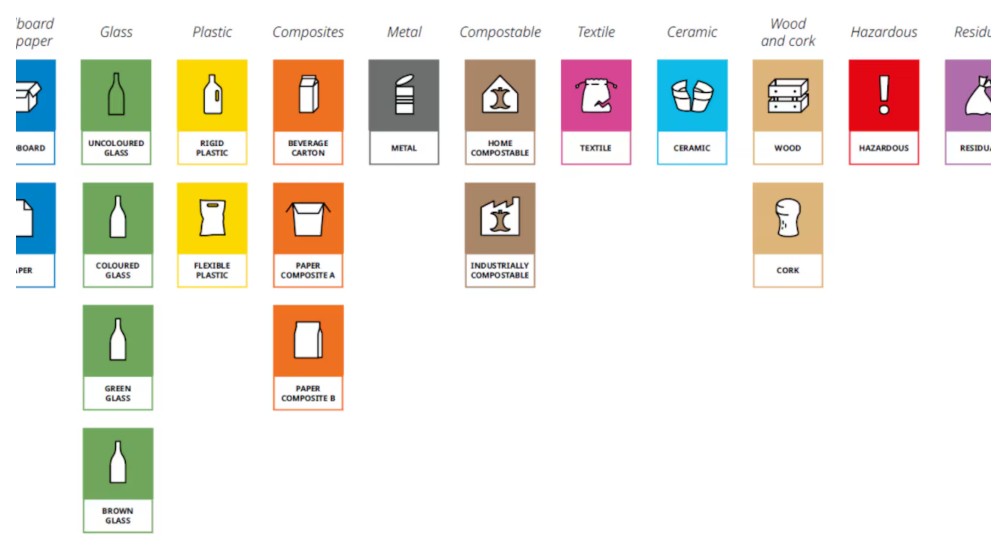
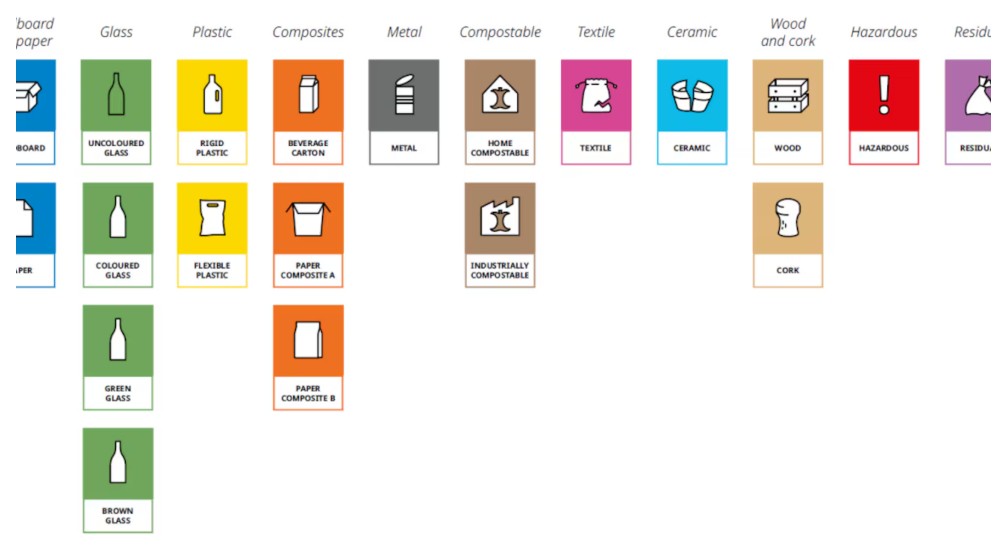
Pictograms and materials as used in the proposed EU harmonised waste sorting labelling scheme (European Commission JCR)
The European Union is preparing a new harmonised labelling system for packaging under the Packaging and Packaging Waste Regulation (PPWR).
Articles 12 and 13 of the PPWR require the European Commission to adopt labelling implementing acts by 12 August 2026. These acts will define the harmonised labels and their specifications, including the visual design, technical formats and digital provisions.
From 12 August 2028, any packaging placed on the EU market must be marked with the new labels in order to facilitate consumer sorting. The labels must be based on pictograms and be easily understandable, including for persons with disabilities.
In preparation for the 12 August 2026 deadline, the European Commission’s Joint Research Centre (JRC) has published their proposal for what the new labels should look like.
The proposal is based on desk research, citizen and stakeholder workshops, large-scale online surveys and behavioural experiments. These activities involved more than 25,000 citizens and 250 stakeholders.
At present, inconsistent national rules and unclear labels are a major cause of contamination in recycling streams.
The proposed system aims to tackle this by introducing clear, material-based labels that work the same way across all member states, regardless of how local collection systems are organised.
Two plastic categories
For plastic packaging, the JCR proposes using two label categories: rigid plastic and flexible packaging. A so-called “meta-label” would combine the two plastic categories to represent plastic packaging in general.
The EU research body said that greater granularity (ie PET, HDPE, PP etc) would overwhelm consumers and offer little benefit, given that most plastic sorting takes place at industrial facilities rather than at home.
Behavioural testing showed that simpler categories improve understanding and sorting accuracy, while still supporting high-quality recycling.
Although most EU countries do not currently collect rigid and flexible separately, and most households place them in the same bin, the JCR found that “maintaining distinct labels for rigid and flexible plastics, alongside a combined meta-label, could accommodate diverse national practices.”
Nonetheless, the JCR acknowledged that further discussion is required to decide whether there should be a single “meta-label”, only separate rigid and flexible labels, or both.
Plastic-based composite packaging should be labelled according to the form of its dominant plastic component. Rigid plastic-based composites should be labelled as rigid plastic; flexible plastic-based composites should be labelled as flexible plastic.
Plastic-based composites are defined as packaging made predominantly of plastic, combined with one or more other materials (eg steel, glass, or aluminium) that contribute to the total weight of the main packaging material and cannot be separated manually. Materials that account for less than 5% of the total packaging mass are considered insignificant and excluded from this definition, as are labels, varnishes, paints, inks, adhesives and lacquers.
For beverage cartons, which are composites made predominantly by paper with a thin layer of plastic, the JCR is proposing their own ‘beverage carton’ label.
Plastic packaging often consists of multiple components, for example, a rigid tray with a flexible film lid. The proposed system allows multiple labels on a single package, encouraging consumers to separate components where possible and sort each material correctly.
Where separation is not feasible, or where packaging is contaminated or made from plastics without an established recycling route, a residual waste label acts as a fallback, directing items away from recycling streams.
Member States will also be allowed to complement labels with aditional information, including digital tools such as QR codes linking to country-specific guidance.

All label variants for the plastic "meta-label" proposed by the JCR. The left-side pictogram represents flexible packaging; the right-side represents rigid packaging (European Commission JCR)
Colour encouraged, but not mandatory on packaging
The JRC did not make colour labelling mandatory on packaging, citing cost, printing constraints and branding concerns raised by industry. However, it noted that behavioural evidence suggests black-and-white labels may reduce sorting accuracy.
For waste bins, the JCR is proposing using a matching system: the same pictogram used on plastic packaging will appear on the corresponding waste receptacle. Consumers are expected to sort by visually matching symbols, rather than reading country-specific instructions such as “yellow bin” or “plastics and metals.” This is required because countries currently colour code their waste bins by final destination rather than by material, as proposed by the new packaging labelling system.
This approach allows the EU to harmonise labels without forcing member states to change how they collect waste. A plastic item may end up in different coloured bins depending on the country, but the label on the packaging stays the same.
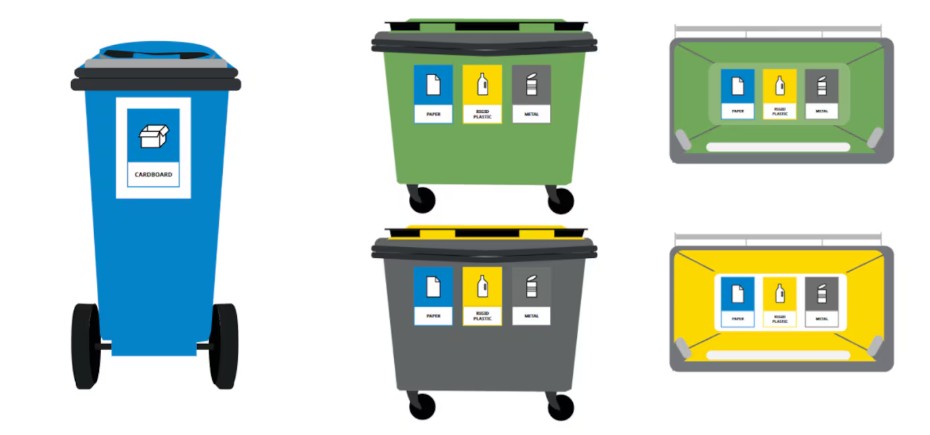
Examples of possibilities to apply labels with various colours to waste bins (European Commission JCR)
If adopted, the harmonised labels will gradually replace existing national schemes, with current labels to be phased out by 2028. Packaging placed on the market before the new rules take effect may remain for a limited transition period.
* Source : https://www.plasticsnews.com/public-policy/sp-ppwr-labels-sorting-plastic-packaging/